Wednesday, April 22, 2026
Why AI-Native Is Different From AI-Enabled

There is a phrase you are going to hear a lot over the next few years.
AI-powered. AI-enabled. AI-driven. AI-enhanced. The specific word changes but the underlying claim is the same: we have taken our existing product and added artificial intelligence to it, and that makes us a more capable, more modern, more competitive company.
Some of those claims are genuine. Most of them are not.
Because there is a fundamental difference between a company that has added AI to its product and a company that was built on AI from the ground up. And in payments, that difference is not a marketing distinction. It is an architectural one. It shows up in your latency, your accuracy, your compliance posture, your ability to scale, and your ability to get better over time without proportional increases in cost and headcount.
Let us talk about what that difference actually looks like.
What AI-Enabled Looks Like
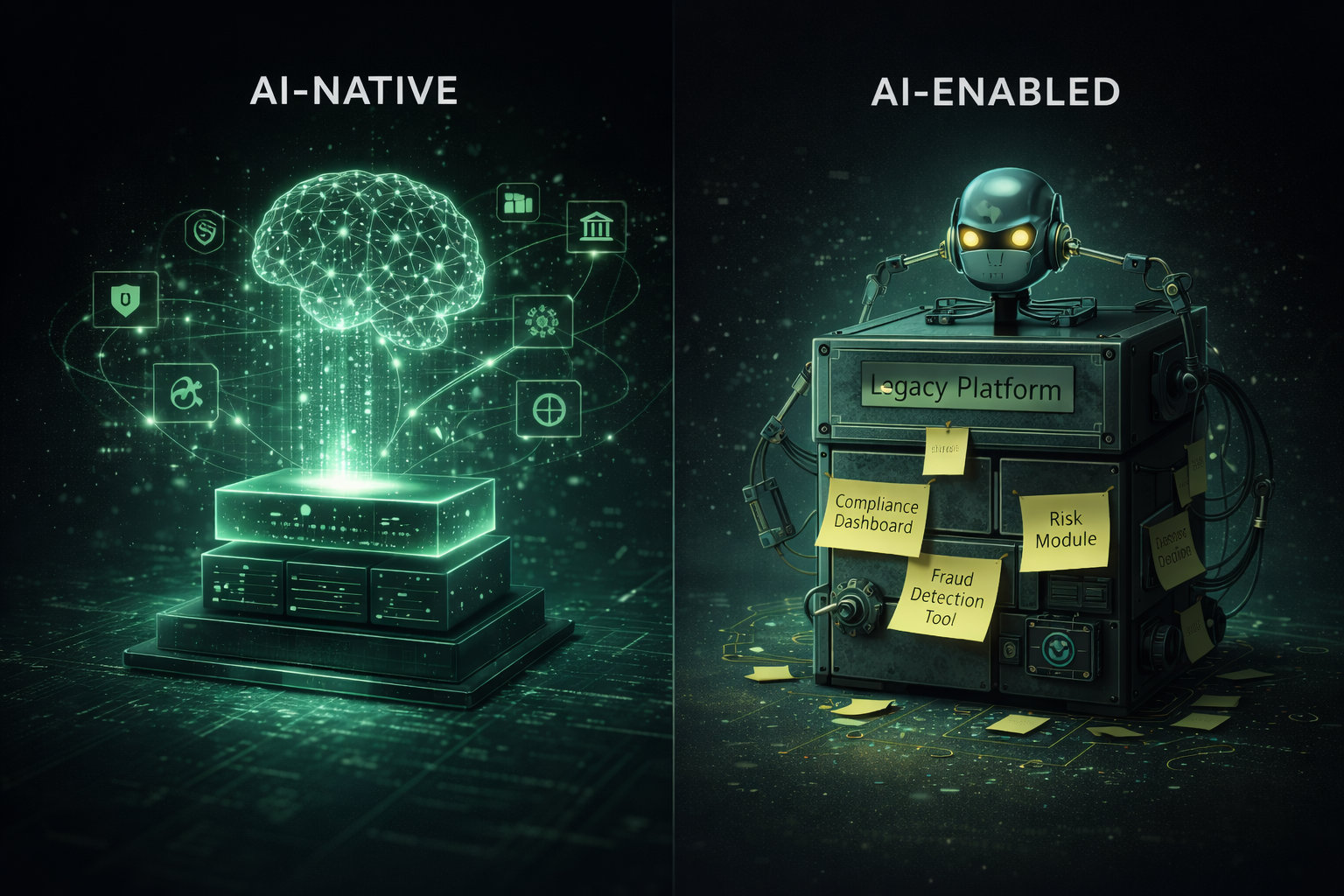
AI-enabled is what happens when a company builds a product and then figures out where AI can improve it.
It is a fraud detection model layered on top of a rules engine that was already there. It is a compliance dashboard with an anomaly detection feature added in a later release. It is a risk scoring system that runs alongside the existing decision logic and sometimes overrides it. It is a chatbot sitting on top of a support system that was not designed for it.
None of those things are bad. Some of them are genuinely useful. But they share a common characteristic: AI is additive. It sits on top of an architecture that was designed without it. It improves specific outcomes in specific contexts. And it has a ceiling, because the architecture underneath it was not built to let it do more.
AI-enabled companies are playing catch up. They are taking something that was built for a different era and trying to make it competitive with something that was not.
What AI-Native Looks Like
AI-native is what happens when intelligence is the foundation, not the feature.
When you build AI-native, you do not ask where AI can improve your existing product. You ask what the product would look like if intelligence was assumed from the start. Every architectural decision is made with the intelligence layer in mind. Every data flow is designed to feed it. Every output is designed to be informed by it.
The result is not a product with AI features. It is a product where AI is the operating principle.
At Anton Payments, Anton Engine is not a module we added to our payout infrastructure. It is the core around which the infrastructure was built. Every transaction that flows through our platform runs through five intelligence layers simultaneously. Every decision is informed by signals that a static system could not process in any reasonable timeframe. And every outcome feeds back into the model, making it more accurate with every transaction it processes.
That is not something you retrofit. You have to build for it from day one.
The Practical Differences
The gap between AI-enabled and AI-native shows up in measurable ways.
Speed is one of them. When intelligence is architectural, it operates at the speed of the infrastructure. Anton Engine makes risk decisions in under 100 milliseconds because the intelligence layer is not a separate system making a separate API call. It is integrated into the transaction flow at the infrastructure level.
Accuracy is another. AI-enabled systems typically operate on a subset of available signals because the architecture was not designed to route everything through the intelligence layer. AI-native systems operate on everything, because everything was designed to flow through them.
Improvement over time is the most important one. AI-enabled systems get better when someone updates the model or adds new training data. AI-native systems get better automatically, because every interaction is designed to be training data. The system compounds in value as it processes more transactions. The gap between an AI-native platform and an AI-enabled one widens over time, not narrows.
Why This Matters in Payments Specifically
Payments is one of the domains where the difference between AI-native and AI-enabled has the most tangible consequences.
The signals that determine whether a transaction is legitimate or fraudulent, whether a payout should be routed one way or another, whether a merchant's risk profile has changed, these signals are complex, high-dimensional, and constantly evolving. Static rules cannot capture them. AI bolted onto a legacy system can approximate them. AI built into the foundation of the platform can actually understand them.
The compliance dimension matters too. In regulated financial environments, the intelligence layer needs to produce decisions that are not just accurate but auditable. Every risk decision Anton Engine makes is logged with the full set of signals that informed it. That is not a feature we added. It is a property of an architecture that was designed with compliance in mind from the start.
From Ryan Olson, Founder and CEO
"The phrase AI-native gets used loosely. For us it has a very specific meaning: intelligence is not something we added to Anton Payments, it is what Anton Payments runs on. Anton Engine is not a feature of the platform. It is the platform. Every payout, every risk decision, every compliance check runs through it. That is what we mean when we say Anton Payments is the AI."
The Standard Is Shifting
Right now, AI-enabled is enough to be competitive in most markets.
That window is closing.
As AI-native platforms mature and scale, the performance gap between them and AI-enabled competitors will become impossible to close through iteration alone. The architecture underneath an AI-enabled product limits how good it can get. An AI-native product has no such ceiling.
The companies that are building AI-native today are building the infrastructure that the next decade of financial services will run on.
We are one of them.
Anton Payments is not using AI. Anton Payments is the AI.