Wednesday, April 29, 2026
The Real Cost of Fragmented Payments Infrastructure

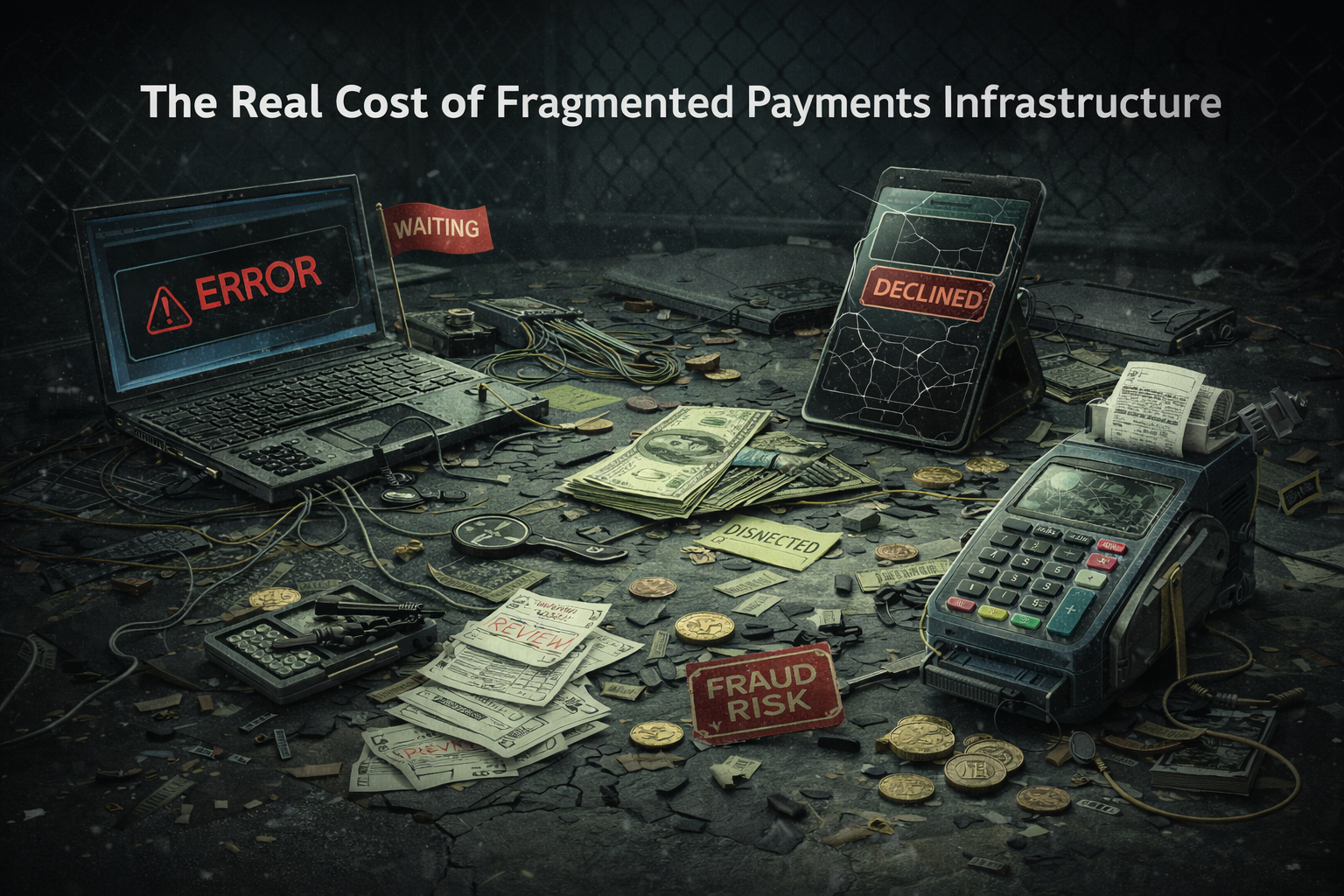
Most companies do not realize their payments infrastructure is fragmented until it starts costing them in ways that are very hard to ignore.
By then, the damage is already done.
The fragmentation usually happens gradually. A payout provider here. A compliance tool there. A risk system that does not quite talk to the fraud detection layer. A settlement process that requires manual intervention because the data coming out of one system does not match the format the next one expects. A reporting function that requires someone to pull from three different dashboards and reconcile the results in a spreadsheet.
Each individual piece seemed reasonable at the time it was added. Together, they create an operational reality that is slower, more expensive, more error-prone, and more difficult to scale than anyone planned for.
This is the real cost of fragmented payments infrastructure. And it is much higher than most companies have calculated.
The Visible Costs
Some of the costs of fragmentation are visible and quantifiable.
Operational overhead is the most obvious one. When your systems do not integrate cleanly, humans fill the gaps. Manual reconciliation. Manual exception handling. Manual reporting. Manual compliance checks that should be automated but cannot be because the data lives in too many places in too many formats. Every one of those manual processes is headcount you are paying for to compensate for infrastructure that was not designed to work together.
Settlement delays are another. Fragmented systems introduce latency at every handoff point. A payout that should settle in hours takes days because it has to pass through multiple systems, each with its own processing window, its own failure modes, and its own retry logic. That latency has a real cost for the businesses depending on those payouts.
Error rates go up too. Every integration point between fragmented systems is a potential failure point. The more systems involved in a transaction flow, the more opportunities for something to break, for data to be lost or corrupted in transit, for a payout to land in an error state that requires manual investigation to resolve.
The Invisible Costs
The invisible costs of fragmentation are harder to quantify but often more damaging.
Compliance exposure is one of them. When your compliance data is spread across multiple systems that do not share a common data model, maintaining a complete and accurate picture of your risk posture becomes genuinely difficult. Audits take longer. Gaps appear in your documentation. The kind of real-time visibility that regulators and banking partners expect becomes impossible to provide because the data does not exist in one place.
Opportunity cost is another. Every engineering hour spent maintaining integrations between fragmented systems is an engineering hour not spent building the capabilities that actually grow the business. The maintenance burden of fragmented infrastructure compounds over time. The more systems you add, the more integration work you inherit, and the slower your ability to ship new capabilities becomes.
Banking relationship risk is the one that surprises companies the most. Your banking partners and rail providers evaluate your operational infrastructure as part of their ongoing risk assessment of you as a partner. Fragmented, manual, error-prone infrastructure is a signal. It tells them that your operational risk is higher than it should be. And in payments, that signal has consequences.
What Unified Infrastructure Actually Looks Like
The alternative to fragmented infrastructure is not a single monolithic system that does everything. It is a coherent architecture where every component is designed to work together, share data cleanly, and expose a consistent operational view across the entire platform.
At Anton Payments, every layer of our infrastructure is integrated by design. Our risk intelligence, our compliance tooling, our identity verification, our payout routing, our data security layer, they are not separate systems connected by fragile integrations. They are components of a unified platform that was designed from the start to operate as a single coherent whole.
That means Anton Engine has access to the full signal picture across every transaction. It means our compliance posture is visible in real time rather than reconstructed after the fact. It means our partners get a single integration point rather than a collection of separate APIs they have to manage individually. And it means our operational overhead is a fraction of what it would be if we had built the same capabilities as separate, fragmented systems.
From Ryan Olson, Founder and CEO
"I have seen what fragmented infrastructure does to payments companies at scale. It starts as a minor inconvenience and becomes a structural constraint. You reach a point where you cannot move fast enough to compete because too much of your engineering capacity is keeping the existing systems talking to each other. We designed Anton Payments specifically to avoid that outcome. Unified infrastructure is not a nice-to-have at scale. It is the difference between a platform that compounds in capability and one that compounds in technical debt."
The Compounding Problem
Here is the thing about fragmented infrastructure that makes it so dangerous.
It gets worse over time, not better.
Every new market you enter requires new integrations. Every new compliance requirement requires new tooling. Every new payout rail requires new connections into an existing architecture that was not designed to accommodate them cleanly. The fragmentation compounds. The maintenance burden grows. The gap between what your infrastructure can do and what your business needs it to do widens.
Companies that do not address fragmentation early find themselves in a position where fixing it later requires a rebuild that is expensive, risky, and disruptive to the business they have already built.
The right time to build unified infrastructure is before you need it.
This Is What We Built Anton Payments For
Anton Payments exists to give serious businesses access to payments infrastructure that was designed to work as a unified whole from day one.
Not a collection of tools. Not a patchwork of integrations. A coherent platform where every component is designed to share data, inform decisions, and operate as part of a single intelligent system.
The cost of fragmented infrastructure is real. The alternative is Anton Payments.
Anton Payments is not using AI. Anton Payments is the AI.